


Implied Probability in Sports Betting: How Odds Are Converted to Probability, How Overround Is Identified, and How to Use It to Assess Bet Value
What Is Implied Probability?
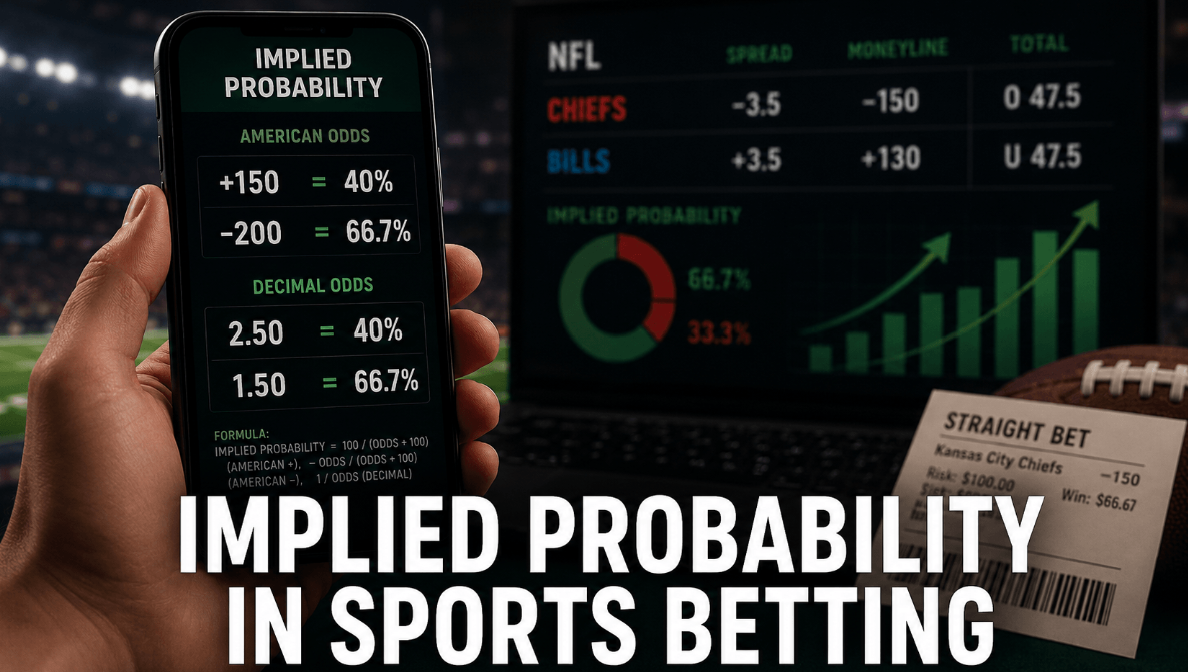
Implied probability is the likelihood of an outcome as encoded in the odds a bookmaker sets. When a bookmaker prices a football match, they are not simply assigning a number — they are embedding a probability estimate into every figure on the board. Converting those odds back into a percentage gives you the implied probability: the bookmaker's internal prediction of how often that outcome should occur, adjusted for their margin.
The word "implied" carries weight here. The figure does not come from a neutral statistical source — it reflects the bookmaker's model plus their built-in edge. Before placing any wager through platforms accessible via 1xbet mobil indir android, understanding how to extract implied probability turns a listed price from a raw number into actionable analytical information.
Implied probability is expressed as a percentage. A figure of 60% means the bookmaker is pricing the outcome as though it occurs six times in every ten. A figure of 25% means once in four.
How Implied Probability Differs from True Probability
True probability refers to the actual, theoretical likelihood of an event occurring, independent of any bookmaker's margin. If a fair coin is tossed, the true probability of heads is exactly 50%. In sports, true probability is never known with certainty — it must be estimated through independent analysis of form, statistics, team news, and context.
Implied probability is always inflated relative to true probability because bookmakers build a margin into their pricing. This margin — called the overround, the vig, or the juice — ensures the sum of implied probabilities across all outcomes in a market exceeds 100%. The gap between implied probability and true probability is precisely where value exists or is absent in any bet.
How to Convert Odds to Implied Probability
Converting Decimal Odds to Implied Probability
Decimal odds are the standard format in most European and Asian markets. The formula is:
Implied Probability (%) = (1 ÷ Decimal Odds) × 100
Converting American Odds to Implied Probability
American odds — also called moneyline odds — are expressed as positive or negative integers. The formula differs by sign.
For positive American odds (underdog, e.g., +250): Implied Probability (%) = 100 ÷ (Odds + 100) × 100
For negative American odds (favourite, e.g., −150): Implied Probability (%) = |Odds| ÷ (|Odds| + 100) × 100
Converting Fractional Odds to Implied Probability
Fractional odds, standard in UK markets, express profit relative to the stake. The formula is:
Implied Probability (%) = Denominator ÷ (Numerator + Denominator) × 100
Step-by-Step Numeric Examples Across All Three Formats
Example 1 — Decimal odds of 2.50:
- Divide 1 by 2.50 → 0.40
- Multiply by 100 → 40%
Example 2 — American odds of +150:
- Add 100 to 150 → 250
- Divide 100 by 250 → 0.40
- Multiply by 100 → 40%
Example 3 — American odds of −200:
- Take absolute value → 200
- Add 100 → 300
- Divide 200 by 300 → 0.6667
- Multiply by 100 → 66.67%
Example 4 — Fractional odds of 3/2:
- Denominator = 2; Numerator = 3
- Divide 2 by (3 + 2) → 0.40
- Multiply by 100 → 40%
What the Overround Is and How to Identify It
How Summing Implied Probabilities Reveals the Overround
The overround is the total excess probability embedded across a market. To identify it, convert every outcome's odds to implied probability and sum all figures:
Overround (%) = Sum of all implied probabilities − 100%
Any result above 100% indicates a margin. A total of 106% means the bookmaker holds a 6% overround across that market.
Step-by-Step Example: Calculating Overround on a Football Match
Consider a standard football 1X2 market:
|
Outcome |
Decimal Odds |
Calculation |
Implied Probability |
|
Home Win |
2.10 |
1 ÷ 2.10 × 100 |
47.62% |
|
Draw |
3.40 |
1 ÷ 3.40 × 100 |
29.41% |
|
Away Win |
3.60 |
1 ÷ 3.60 × 100 |
27.78% |
|
Total |
104.81% |
Overround = 104.81% − 100% = 4.81%
For every 100 units distributed across all three outcomes, the bookmaker retains approximately 4.81 units in margin regardless of the result.
What a Typical Overround Looks Like Across Different Markets
Overround varies significantly by market type. Two-outcome markets such as tennis match winners carry tighter margins. Three-outcome football 1X2 markets sit in the mid-range. Exotic markets — correct score, first goalscorer — carry substantially higher margins because the number of possible outcomes multiplies the embedded edge.
How Implied Probability Is Used to Assess Bet Value
What Value Betting Means in Terms of Implied Probability
A value bet exists when the bookmaker's implied probability is lower than your estimated true probability of the outcome. The formal condition is:
Value exists when: Implied Probability < Your Estimated True Probability
Expected value (EV) quantifies this advantage. Positive EV means the bet should generate profit across a large enough sample. A single value bet does not guarantee profit — variance means any individual wager can lose — but consistently identifying positive EV is the foundation of sustainable betting.
How to Compare Implied Probability Against Your Own Estimate
- Analyse the match independently: form, head-to-head record, team news, motivational factors.
- Assign your own probability estimate to each outcome before consulting the odds.
- Convert the bookmaker's odds to implied probability using the appropriate formula.
- Compare your estimate against the bookmaker's figure.
- Where your estimate exceeds the implied probability, a value position exists.
The critical discipline is forming your probability estimate before looking at the price, so the odds do not anchor your independent judgment.
Step-by-Step Example: Identifying a Value Bet Using Implied Probability
A bookmaker prices Arsenal to win at decimal odds of 2.50.
- Implied probability: 1 ÷ 2.50 × 100 = 40%
- Your independent analysis estimates Arsenal's true win probability at 48%
- 48% > 40% → the bet carries positive expected value
- EV: (0.48 × 1.50) − (0.52 × 1) = 0.72 − 0.52 = +0.20 per unit staked
If your estimate is correct over a large sample, this bet returns +0.20 units in expectation for every unit wagered.
Responsible gambling note: Value betting is a long-term probabilistic approach. Results fluctuate in the short run, and no method eliminates the risk of loss. Only wager amounts you can comfortably afford to lose.
How Implied Probability Changes in Live Betting
How Real-Time Events Shift Implied Probability
In live betting, implied probability recalculates continuously. A goal instantly compresses the winning team's implied probability from its pre-goal level and expands the trailing team's. A red card has a similarly immediate effect. These recalculations happen algorithmically, typically within seconds of each event being confirmed.
Bettors who understand how implied probability should theoretically shift after an event can compare that expected recalibration to how the bookmaker has actually repriced the market. When repricing lags, a brief window of mispricing may emerge — a function of market efficiency closing slowly.
How Odds Suspension Relates to Probability Recalculation
When a significant event occurs — a goal, a penalty award, a VAR review — bookmakers suspend the market momentarily. This suspension is the operational window in which the pricing algorithm recalculates all implied probabilities based on the new match state. When the market reopens, the probabilities for win, draw, and loss will have shifted to reflect updated game dynamics. Bettors familiar with odds conversion can assess quickly whether the new prices represent fair recalibration or a temporary gap.
Implied Probability Conversion Table: Decimal, American, and Fractional
|
Decimal Odds |
American Odds |
Fractional Odds |
Implied Probability (%) |
Formula Applied |
|
1.25 |
−400 |
1/4 |
80.00% |
1 ÷ 1.25 × 100 |
|
1.50 |
−200 |
1/2 |
66.67% |
1 ÷ 1.50 × 100 |
|
2.00 |
+100 |
1/1 |
50.00% |
1 ÷ 2.00 × 100 |
|
2.50 |
+150 |
3/2 |
40.00% |
1 ÷ 2.50 × 100 |
|
3.00 |
+200 |
2/1 |
33.33% |
1 ÷ 3.00 × 100 |
|
4.00 |
+300 |
3/1 |
25.00% |
1 ÷ 4.00 × 100 |
|
6.00 |
+500 |
5/1 |
16.67% |
1 ÷ 6.00 × 100 |
|
10.00 |
+900 |
9/1 |
10.00% |
1 ÷ 10.00 × 100 |
Overround Comparison Table: Market Types and Typical Margins
|
Market Type |
Outcomes |
Typical Overround (%) |
Implied Probability Sum |
Margin per Outcome |
Example |
|
Two-Way (No Draw) |
2 |
2–4% |
102–104% |
1–2% |
Tennis match winner |
|
Asian Handicap |
2 |
2–5% |
102–105% |
1–2.5% |
Football AH line |
|
1X2 Three-Way |
3 |
4–8% |
104–108% |
~1.5–2.7% |
Football league match |
|
Over/Under |
2 |
3–6% |
103–106% |
1.5–3% |
Football O/U 2.5 goals |
|
Correct Score |
10–20 |
15–30% |
115–130% |
Variable |
Football correct score |
|
First Goalscorer |
15–30 |
20–40% |
120–140% |
Variable |
Football goalscorer |
|
Outright Winner |
10–40 |
15–35% |
115–135% |
Variable |
League winner market |
How Implied Probability Applies to Parlay and Accumulator Bets
In a parlay or accumulator, individual selections are combined so the payout from one leg rolls into the next. The total implied probability of the accumulator is found by multiplying the individual implied probabilities of each selection expressed as decimals.
For a three-leg accumulator with implied probabilities of 50%, 40%, and 33.33%:
Accumulator Implied Probability = 0.50 × 0.40 × 0.3333 = 0.0667 = 6.67%
The bookmaker effectively prices this as an event occurring roughly once in fifteen attempts. Each additional leg multiplies the embedded margin, meaning a five-leg accumulator where each leg carries a 5% overround compounds to an effective total margin exceeding 20%. Bettors evaluating accumulator value must assess each leg's implied probability independently before combining them, and account for how rapidly compounding margin erodes expected value.
Common Mistakes When Interpreting Implied Probability
- Treating implied probability as true probability. The bookmaker's figure includes their margin. It is not a neutral estimate of actual event likelihood, and should not be used directly as a benchmark without stripping out the overround.
- Ignoring the overround when comparing prices across bookmakers. A higher headline price on one platform can still carry a higher effective margin in certain markets — always calculate the full market overround, not just the price on one outcome.
- Anchoring personal estimates to the bookmaker's odds. Consulting the price before forming your own probability view biases your estimate toward the bookmaker's figure, removing the independence necessary to identify genuine value.
- Treating a single value bet as a guaranteed outcome. Positive EV produces profit in expectation over large samples, not on any individual wager. Short-run variance is substantial.
- Underestimating compounding margins in accumulators. Each additional leg adds the bookmaker's margin multiplicatively, making effective overround in multi-leg bets significantly higher than in single markets.
- Mixing up the American odds formula for positive and negative lines. The two formulas are structurally different — applying one where the other applies produces an entirely incorrect implied probability reading.
FAQ
Q: What is the formula to convert decimal odds to implied probability? A: Divide 1 by the decimal odds, then multiply by 100. Decimal odds of 3.00 give: 1 ÷ 3.00 × 100 = 33.33%.
Q: How do I calculate implied probability from American odds? A: For positive odds (e.g., +250): 100 ÷ (250 + 100) × 100 = 28.57%. For negative odds (e.g., −150): 150 ÷ (150 + 100) × 100 = 60%. The formula changes based on whether the figure is positive or negative.
Q: How do I identify the overround in a market? A: Convert every outcome to an implied probability percentage and sum all figures. Subtract 100 from the total. A sum of 107% gives an overround of 7%. The larger the sum above 100, the higher the bookmaker's margin on that market.
Q: What does it mean for a bet to have value? A: A bet has value when your independently estimated true probability of the outcome exceeds the bookmaker's implied probability. If you estimate a 55% chance of a result and the odds imply only 44%, the bet carries positive expected value — the price is higher than it should be relative to your estimate.
Q: How does implied probability work in an accumulator? A: Multiply the individual implied probabilities — expressed as decimals — for each selection. Three legs at 50%, 60%, and 40% give a combined implied probability of 0.50 × 0.60 × 0.40 = 0.12, or 12%. Each additional leg adds further compounded margin.
Q: What is favourite-longshot bias and how does it affect implied probability? A: Favourite-longshot bias is a systematic pattern where implied probabilities for heavy favourites tend to underestimate actual win rates, while implied probabilities for large underdogs tend to overestimate theirs. This means the bookmaker's implied figure is not always a neutral reflection of their true model, particularly at the extreme ends of the odds range — a consideration when applying probability analysis to heavily skewed markets.

http://www.japanese-school-asahi.com/






Leave a Reply
You must be logged in to post a comment.